
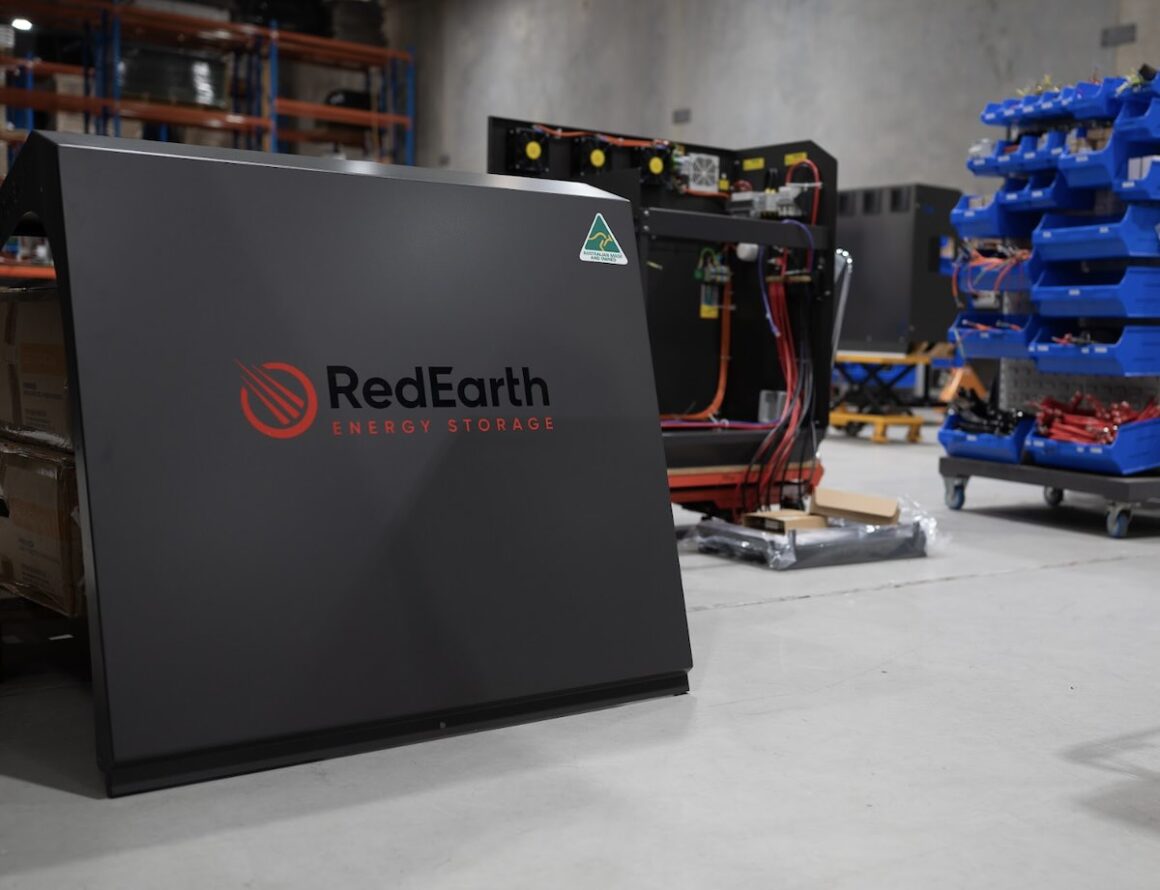
The Australian home battery outfit whose customers include federal energy minister Chris Bowen has a new all-in-one residential solution in the works that will combine solar, storage and bidirectional electric vehicle (EV) charging, in a streamline distributed energy with electric mobility.
The new product, billed as the world’s first residential “microgrid-in-a-box” (MIB), is the result of a partnership between Australian battery maker RedEarth, China’s Nebula Electronics and Germany’s ambibox.
RedEarth says the “technical alliance” will leverage each party’s core competencies in technology innovation, industrial manufacturing and localised market operations to deliver a “scalable and affordable energy management and distribution system.”
RedEarth CEO Marc Sheldon says the main thing to note about the new battery is that “it’s not just a battery,” but rather “a combination of pretty much everything” needed to run an efficient electric home and car.
“We’ll take the solar inverter, we’ll take the hybrid inverter, we’ll take the [bi-directional] EV charger and a few other things and we’ll put it all into one system, which is modular and software driven.”
Sheldon says the MIB’s various capabilities can be enabled through software, making them ready to go when the customer needs them – and massively reducing the cost of the technologies compared to if they were bought and installed separately.
“We haven’t yet released our pricing, we will very shortly,” Sheldon tells One Step Off The Grid. “But for the separate systems, you put them all together, let’s say a hybrid converter and a bidirectional charger and a solar system, you’ll be saving with the new (MIB) system more than 40%.”
Brisbane-based RedEarth Energy Storage, best known for its off-grid energy storage solutions, hit the residential radar in Australia in 2021, when its Troppo product became the first fully Australian designed and assembled home batteries to get Clean Energy Council approval.
Last year, minister Bowen revealed that he had bought a Troppo battery to support his home solar system after a visit to the company’s stand at the 2023 Smart Energy Conference & Exhibition.
“I checked out their products closely,” Bowen told RenewEconomy at the time. ”And as a direct result of that visit, I now have one helping power our house and supporting the grid very efficiently.”
He may soon wish to upgrade. RedEarth says real-world testing of the new MIB shows it can reduce overall energy costs for users by up to 60 per cent, with the potential to also generate revenue for homeowners.
Sheldon says that the MIB could also be used as a standalone system – that is, without rooftop solar – and used to leverage negative electricity prices during the day to charge up the car or the battery and then use the stored power for the house during evening peaks.
It’s also stackable with existing solar systems and inverters, offering the potential to size-up the existing PV and add EV charging to the mix. And it can be used as a stand-alone EV charger.
“Our product is an all-in-one system where feature sets are actually enabled using software, so you don’t need to add additional modules to it. And … our system will be fully 4777 certified, so you can use it purely as a standalone EV charger,” Sheldon says.
“That’s a critical component. …You can use it as a solar inverter. You can use it as a battery; inverter with a battery. You can use it as a charger, or you can use it in any one of those three combinations.
“The partnership with ambibox and Nebula Electronics will deliver new opportunities for households to realise their potential to be truly energy independent,” Sheldon says.
“Using their electric vehicle as a battery means they can use the energy on their vehicles to power their home instead of relying solely on a home battery or grid electricity.”
Manfred Przybilla, CEO of ambibox, said his company has been working on the Microgrid-in-Box for almost a decade and, with the advancement in vehicle to home and grid capabilities in EVs, is now ready to hit the market.
“We’ve demonstrated our experience in the field with the launch of over 200 commercial V2G pilot projects in Sweden, validating the system’s reliability under demanding conditions,” he said.
The first batch of jointly developed products is expected to enter the markets of China, Europe, and Australia/New Zealand in 2026, with plans to expand to other regions.
The MIB will be manufactured for the Australian and New Zealand market by RedEarth at their existing Darra, Queensland facility.

Sophie is editor of One Step Off The Grid and deputy editor of its sister site, Renew Economy. Sophie has been writing about clean energy for more than a decade.
The post Solar, storage and EV charging in one: Australian battery maker announces “microgrid in a box” appeared first on One Step Off The Grid.
